

Choose Your Integration
Identify which integration type is right for your use case.
With PayMitto you'll be able to integrate cross-border payments, disbursements or remittances in a matter of weeks. This guide will help you get started by identifying your integration type and choosing the right integration guide. If you have any questions, please get in touch with the PayMitto Integrations Team.
1. Identify Your Integration Model
Before choosing an integration path, you need to identify two things: the transfer type and the sender model. Together these determine which integration options are available to you.
Transfer type
PayMitto Transfers are classified as Business-to-Consumer (B2C), Business-to-Business (B2B), or Consumer-to-Consumer (C2C). The key differentiator is the source of the funds.
In the B2C and B2B use cases, funds originate from a business's account and are disbursed to consumers or other businesses. The Sender is a business, and the Recipient entities are the consumers or businesses receiving funds.
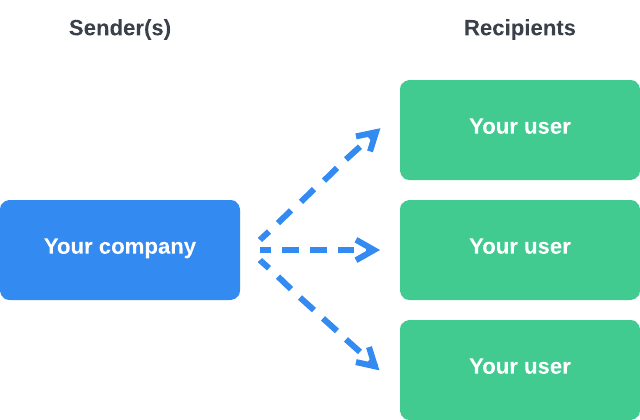
Business-to-Consumer (B2C)
In the C2C use case, funds originate with consumers and are sent to either themselves or a friend or family member. The Sender is a consumer, and the Recipient entities represent that consumer sending money to themselves or another person.
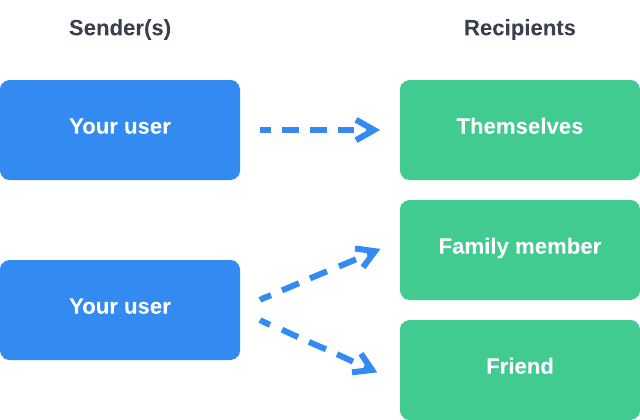
Consumer to Consumer (C2C)
Sender model
Just as important as the transfer type is how many senders your integration needs to support. There are two models:
Embedded, multi-sender — You are a financial institution (or other platform) embedding PayMitto and offering it to your customers. You have one client account (you), but many senders (each of your end customers). This model can support C2C, B2C, and B2B transfers, but note that only C2C is available via the SDK — B2C and B2B require an API integration. In this model you create and manage a Sender record for each of your users.
Single-sender disbursement — You are a single business disbursing funds to consumers or other businesses. Here your company is the sender — there is only one sender entity, managed by PayMitto. This model covers B2C and B2B disbursements and requires an API integration.
Requirements by model
| Embedded, multi-sender (C2C) | Embedded, multi-sender (B2C / B2B) | Single-sender disbursement (B2C / B2B) | |
|---|---|---|---|
| SDK capable | Yes | No | No |
| Sender KYC required | Yes | Yes | No |
| Sender ID(s) | Created by you for each of your users | Created by you for each of your users | Provided by the PayMitto Integrations Team |
| Number of senders | Many | Many | One |
2. API vs SDK
B2C and B2BIf your identified transfer type is B2C or B2B, only API integrations are supported.
In an SDK integration, several API endpoints are still required from your server, but the PayMitto SDK handles 90% of the transfer flow. This type of integration can dramatically reduce time-to-market. To be eligible for an SDK integration:
- Your transfer types are classified as consumer-to-consumer (C2C).
- You provide your users a mobile and/or web application where the PayMitto SDK can be initiated.
- You don't require any changes to the transfer flow other than cosmetic.
If an SDK integration isn't possible, an API-only integration gives you complete control over the transfer flow for your users.
Updated 4 months ago
What’s Next
Based on your answers to the above items, you can begin integrating with PayMitto today using one of the following integration guides: